

The Geneva drive
How does constant spinning make stop-start motion?
The question
A motor spins one wheel round and round without ever stopping. Yet a film projector needs each picture to sit perfectly still in front of the lens, then jump to the next one. So how can a wheel that never stops make another wheel move in steps and then stay still?
Reveal answer
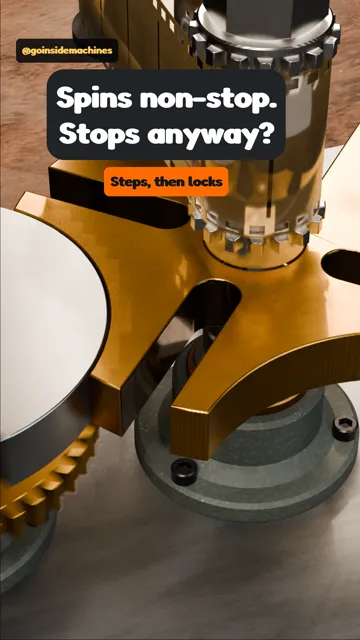
With a pin and a star. The pin on the spinning wheel slides into a slot in the star wheel and turns it one step, then slips out. Right then a round locking disc on the spinning wheel fits into a curved cut in the star and holds it still, until the pin comes round again. This is called a Geneva drive.
Play
Turn the driver
Drag the driver round with your mouse or finger, or press Play. Watch the orange pin slide into a slot and push the star one step. Then watch the round disc lock the star still while the pin is away. Change the number of slots and see how long the star moves and rests. On the film strip, one frame comes by for every step.
What's happening
- 1
The driver is the wheel that spins non-stop. It has two parts: a pin sticking out from its edge, and a round locking disc with a piece cut out of it. The star has slots, and a curved cut between each pair of slots.
- 2
As the driver turns, the pin slides into a slot in the star and pushes the star round one step. With four slots that step is a quarter turn. Then the pin slips out of the slot.
- 3
Now the round locking disc on the driver fits into the star's curved cut and holds the star still, so it cannot drift or be pushed. It stays locked until the pin comes round again and finds the next slot.
- 4
With four slots, the star moves for a quarter of each turn of the driver and rests for the other three quarters. The driver turns 90° while the star moves, and 270° while it is locked.
- 5
Film projectors used it to hold each frame of film still in front of the lens, typically 24 times a second. The film moves only while the shutter blocks the lamp. It is also called a Maltese cross mechanism. The name comes from its earliest use in mechanical watches, which were popularized in Geneva. Watchmakers use a variant, the Geneva stop, with one closed slot, to stop a spring being wound too far.
Simplified, and sources
The widget is an ideal drawing. The parts are perfectly stiff and there is no friction or backlash. The pin is a roller that enters each slot at a right angle, which is how the shapes are worked out from the number of slots. The star turns the opposite way to the driver, as in this kind of Geneva drive. The relief cut in the locking disc and the curved cuts in the star are drawn to look right, and a real one is made with a bit of clearance. The film strip is only a picture that moves one frame for each step, it is not a real projector, and the shutter and the lamp are left out.