

Escalator steps
How do escalator steps stay flat?
The question
An escalator goes up a slope, yet every step you stand on is flat. Near the top and the bottom the steps even lie flat side by side, like a moving floor. Further along they turn into a staircase. How do escalator steps stay flat?
Reveal answer
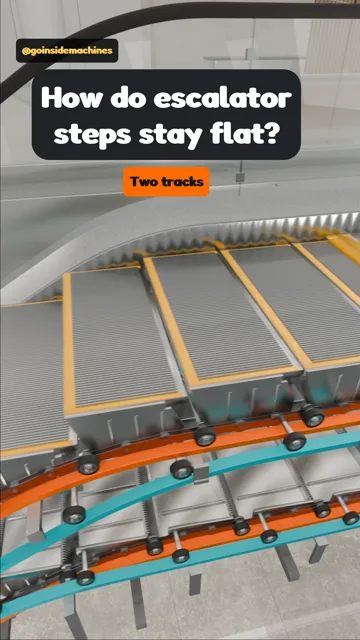
Each step rolls on two tracks, not one. Its front wheels run on one track and its back wheels run on another. On the slope the two tracks are far apart, which holds the step level and makes a staircase. At the top and the bottom the tracks come together, and the steps lie flat.
Play
Move the steps round the loop
Press Play, or drag the slider to move the steps yourself. The blue line is the track the front wheels run on, and the orange line is the track the back wheels run on. Watch how far apart they are on the slope, and how they come together at the top and the bottom. Then press Show one step's wheels to follow the yellow step and see the gap between the tracks.
What's happening
- 1
An escalator is a loop of separate steps joined together in a chain, and a motor drives the chain round. Every step is linked to the next, and the chain cycles on a pair of tracks.
- 2
Each step has wheels at two places. The front wheels run on the step-wheel track. The back wheels, which are set further apart, run on the trailer-wheel track. The two tracks together keep every tread horizontal.
- 3
On the straight slope the tracks are at their greatest distance apart. That forces the steps into a staircase. At the top and the bottom the tracks come together, so the steps lie flat and you step onto a moving floor.
- 4
At the top the chain goes round the main drive gear, and at the bottom it goes round the return gear. The steps turn over, come back underneath upside down, and turn over again to start the climb. Cleats on the steps mesh with the comb plates at each landing, which keeps the gap there as small as it can be.
- 5
The handrail is pulled along by a chain from the main drive gear, so it moves at the same speed as the steps. Escalators move at about 0.3 to 0.9 metres a second, and they rise at 30 or 35 degrees.
Simplified, and sources
The widget is a drawing of the idea, not of a real escalator. It is not to scale. The number of steps, the size of the gears and the bends where the slope meets the landings are chosen to be easy to see. The back wheel is placed by a simple rule, a fixed spot on each step, so the back track is just the path that spot makes. Real escalators come in many designs, with different step shapes, track layouts and ways of driving the chain and the handrail, and the widget shows one of them. The widget also leaves out the skirt panels, the balustrade and the machinery.