

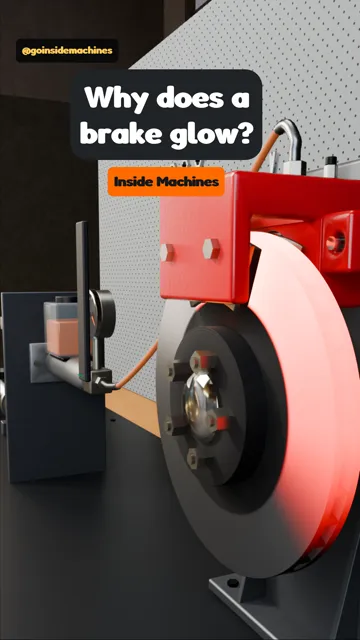
Disc brake
How does a small pedal stop a 1-ton car?
The question
A car weighs about a ton and rolls along fast. You stop it with one foot on a small pedal. Your foot is not strong enough to stop a ton on its own. How does a small pedal stop a 1-ton car?
Reveal answer
Your push gets bigger three times on the way to the wheel. The pedal is a lever, so it pushes the rod harder than your foot pushes the pedal. The rod pushes brake fluid, and the fluid carries that push, as pressure, to a much bigger piston at the wheel. That piston squeezes pads against a spinning disc, and the rubbing turns the car's movement into heat.
Play
Press the pedal and watch the push grow
Press Reset / spin up to get the disc turning. Then drag Press the pedal to the right and watch the push grow at each stage, with the multiplier shown on the way. Change the pedal ratio and the size of the caliper piston to see which one matters most. Watch the disc slow, and the heat bar fill. Brake hard a few times in a row, using Spin up, keep the heat, and see the disc start to glow.
What's happening
- 1
The pedal is a lever. Your foot is far from the pivot and the pushrod is close to it, so the rod gets a bigger push than your foot gives. In a car with a vacuum booster the pedal ratio is about 3.2 to 1 up to 4 to 1. The price is distance: your foot moves further than the rod does.
- 2
The rod pushes a small piston in the master cylinder. Brake fluid is nearly incompressible, which means it hardly squashes at all. So the push arrives at the other end of the pipe. Pressure is the push divided by the area of the piston it pushes on.
- 3
At the wheel the same pressure pushes on a bigger piston in the caliper. The clamping force is the pressure times the area of that piston. A piston with twice the width has four times the area, so it pushes four times as hard.
- 4
The caliper squeezes two pads against the disc. Friction between the pads and the spinning disc slows it, and slows the wheel and the car with it.
- 5
Friction turns the car's movement energy into heat. The disc and pads get hot, and in extreme use, such as racing, the disc can glow red.
The maths
The pedal lever makes the push bigger by the pedal ratio. The fluid turns that push into pressure on the small piston. The same pressure then pushes on the big caliper piston, so the clamp on the pads is
A worked example from a brake-parts site, for an older manual car: 70 lb on the pedal times a pedal ratio of 6.2 is 434 lb. On a 1-inch master cylinder that is about 556 psi, and 2-inch caliper pistons turn it into about 3,419 lb of clamp. In the widget a 20 mm master piston and a 44 mm caliper piston make the area ratio about 4.8, and a pedal ratio of 4 makes the whole chain about 19 times.
Simplified, and sources
The widget is a simplified drawing, not to scale. It leaves out the vacuum booster that most cars have, which adds more push, so the numbers here are illustrative and not from one real car. The pedal ratio goes up to 6 so you can see the lever at work, more than a car with a booster uses. The 1-ton car, the 20 mm master piston, the pad friction, the size of the disc and the way the heat is shared between the four wheels are made up for the drawing. There is no air drag, the tyres are assumed to grip at most about 0.9 g, and the heat bar shows one front disc with a little cooling. Real brakes also have a handbrake, anti-lock control, a front-to-back balance and many other parts that are left out.