

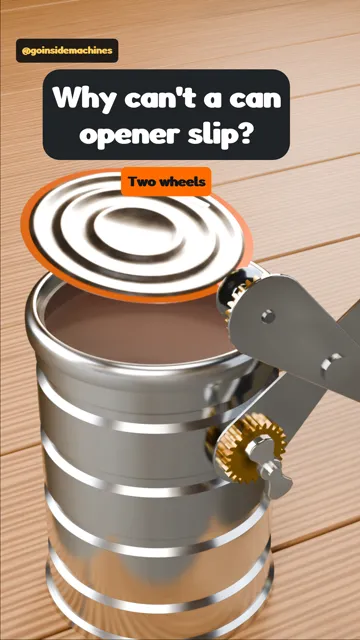
The can opener
How does a can opener cut without slipping?
The question
A can opener has to cut round the lid of a steel can, and cutting takes a push. Yet the opener is only held on the rim by the squeeze of your hand. So why doesn't it just slide off, or spin on the spot, when you turn the key? How does a can opener cut without slipping?
Reveal answer
A serrated feed wheel grips the rim. You squeeze the handles so that the opener holds the rim tightly. The feed wheel then keeps the lid pressed against the cutting wheel, and as you turn the key the wheel moves the can round, so the cutting wheel cuts a little more each turn.
Play
Turn the key yourself
Drag the butterfly key round, or press the button to turn it for you. The orange wheel with the teeth is the feed wheel, and the blue one is the cutting wheel. They turn in opposite directions. First turn the key with a light squeeze and watch the teeth slip. Then squeeze harder with the slider, and see the can turn and the red cut grow round the lid.
What's happening
- 1
A pliers-type can opener has two handles. When you squeeze them, the opener grips the rim of the can tightly. Turning the key rotates the cutting wheel, and it cuts the lid a little at a time along the rim.
- 2
The cutting wheel cuts down through the lid just inside the rim. The rim itself stays attached to the can.
- 3
A serrated feed wheel grips the rim and keeps the lid up against the cutting wheel. The Star Can Opener Company added it in 1925. If the squeeze is too light the teeth slide over the rim and the can does not turn. If it is tight enough, the teeth hold, and the rim moves just as fast as the surface of the feed wheel.
- 4
The cutting wheel and the feed wheel are coupled by interlocking cogwheels, so they turn in opposite directions. The key turns them both, and the can turns the other way to the feed wheel.
- 5
Tin-can canning was patented by Durand in 1810. The first can openers came much later. They were patented in 1855 in England and in 1858 in the US, about 45 years after the can.
Simplified, and sources
The widget is a model, not a real can opener. The numbers on it are illustrative values chosen to show the idea. They are not measurements. The grip is a simple friction rule: the teeth can push the rim with at most the friction coefficient times the squeeze, and they grip once that is at least the force the cutting wheel needs. Real friction is messier, and real openers vary in how they are built. The key is drawn turning in the same plane as the wheels to keep the picture simple, and the handles, the shaft and the size of the wheels are not to scale. The drawing is the view from above and leaves out the lid being pushed down by the cutting wheel.