

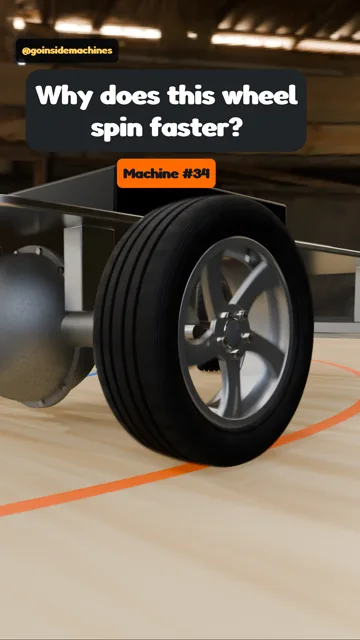
The differential
How do a car's wheels turn at different speeds?
The question
When a car goes round a bend, the wheels on the outside have to travel farther than the wheels on the inside. Yet both driven wheels are joined to the same engine. So how can the two wheels turn at different speeds?
Reveal answer
A set of gears called a differential sits between the engine and the two wheels. It has three shafts: the ring gear that the engine turns, and one for each wheel. Its rule is that the speed of the ring gear is the average of the two wheel speeds. Going straight, the gears just ride round together and both wheels turn the same. In a turn, small spider gears start to spin on their pin, so one wheel slows down and the other speeds up by the same amount.
Play
Round the bend
Slide the steering to drive round a bend. Orange means turning faster than the ring gear, and blue means slower. Watch the two small spider gears inside the differential: they stand still on their pin when you go straight, and spin when you turn. Then put ice under one wheel, and try locking the differential.
What's happening
- 1
In a corner, the outer wheels travel a longer path than the inner wheels, because they are on a larger radius. If both driven wheels were fixed to one shaft, they would have to turn at the same speed, so one would have to slip. Go-karts and trams use axles without a differential and rely on wheel slip when cornering.
- 2
A differential is a gear train with three shafts, where the speed of one is the average of the other two. In a car, the speed of the carrier, which carries the ring gear, is the average of the two wheel speeds. The idea is old: in 1827 Onésiphore Pecqueur included a differential on the driven rear axle in his patent for a steam wagon.
- 3
Driving straight, the ring gear turns the carrier. The spider gears orbit with the carrier but do not rotate on their pin, so both side gears, and both wheels, turn at the same speed.
- 4
Turning, the spider gears rotate on their pin. One side gear slows and the other speeds up by the same amount, so the average, the carrier speed, does not change.
- 5
There is a catch. An open differential can send most of the power to the wheel with less grip. On a slippery patch, that wheel spins while the other gets very little power, and an open differential allows one wheel to stand still while all the power goes to the other. Limited-slip and locking differentials fix this.
The maths
Let Ω be how fast the car swings round the middle of the turn, in radians a second, R the radius of the circle the middle of the axle follows, and w the distance between the two driven wheels. Each wheel is on its own circle, so its ground speed is Ω times its own radius. The carrier speed is the average of the two wheel speeds, written here as turning speeds ω,
These numbers are examples, not facts about a real car. Take a car turning on a circle of radius R = 6 m with its wheels w = 1.5 m apart, and say the middle of the axle moves at 3 m/s. Then Ω = 3 ÷ 6 = 0.5 radians a second. The outer wheel is on a circle of radius 6 + 0.75 = 6.75 m, so it moves at 0.5 × 6.75 = 3.375 m/s. The inner wheel is on 6 − 0.75 = 5.25 m, so it moves at 0.5 × 5.25 = 2.625 m/s. The average is (3.375 + 2.625) ÷ 2 = 3 m/s, the speed of the middle of the axle. In shares of the carrier speed, that is 3.375 ÷ 3 = 112.5% for the outer wheel and 2.625 ÷ 3 = 87.5% for the inner one. Now the ice. If one wheel stands still, the average rule gives (0 + ω_other) ÷ 2 = ω_carrier, so the other wheel must turn at 2 × ω_carrier, which is 200%.
Simplified, and sources
The widget is a simplified kinematic model: it only follows the speeds, not the forces. It shows an open differential with tyres that roll without slipping, except in the ice case, where the icy wheel spins and the other stands still, and in the locked case, where the tyres are drawn scrubbing in a turn. The track width of 1.5 m, the tightest turn of 6 m radius and the 3 m/s are example values, and the front wheels are angled only to match the turn. In the differential view the right side gear is drawn bigger than the left one so that both show, and the two spider gears and the equal gear sizes are drawn to show the idea, not to copy a real axle. Real cars also have friction in the gears, and real tyres slip a little.