

Bike balance
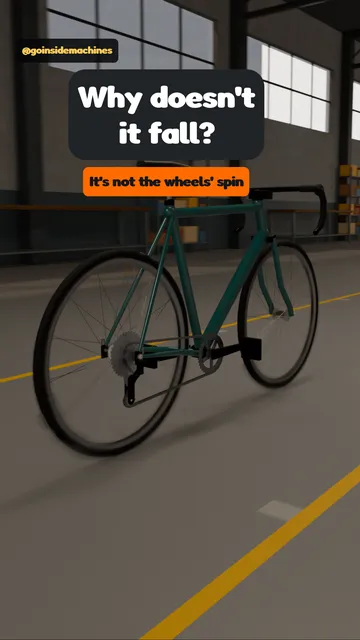
Why doesn't a moving bike fall over?
The question
Push a bike that has nobody on it and it rolls straight on, upright. Stop it and it falls over at once. Gravity pulls on it the same either way. So why doesn't a moving bike fall over?
Reveal answer
The usual answer is that the spinning wheels act like a gyroscope. That is not the main reason. When a moving bike leans, its front wheel turns into the lean, and that steers the wheels back under the bike's weight. A bike that is going fast enough catches itself like this, with nobody on it. A bike doesn't balance on its spin. It steers itself upright.
Play
Knock a riderless bike
Slide the speed, then press Knock it to give the bike a sideways shove. The green band on the slider is the speed range where this bike catches itself. Watch the front wheel turn into the lean, and the lean line settle. Then switch on Lock the steering and knock it again.
What's happening
- 1
A bike that is standing still is like a broom standing up on its handle end. Once it leans, its weight pulls it further over, faster and faster. Nothing puts it back, so it falls.
- 2
The old answer is the gyroscope: spinning wheels resist being tipped, like a spinning top. That helps a little. But in 2011 a team led by Kooijman built a bike with a second pair of wheels turning the other way. That cancelled the spin, and it still balanced itself when pushed (Science).
- 3
The real reason is steering. When the bike leans to the right, the front wheel turns to the right too, on its own, because of how the fork is tilted. The wheels are steered back under the bike's weight, like running a few steps to keep a broom upright.
- 4
It has to be quick enough. Too slow, and the steering cannot catch the fall in time. The front wheel swings from side to side and the wobble, called weave, grows until the bike falls. Too fast, and in this model it slowly leans over into a long, gentle fall instead.
- 5
A rider balances the same way, by steering under the fall. Try it at home: walk a bike beside you, holding it only by the saddle, and tip it gently. The front wheel turns into the lean by itself. Do not hold the handlebars, so the wheel is free to turn.
The maths
The widget runs a standard model of a bicycle, the linearised Carvallo-Whipple bicycle, in the form written down by Meijaard, Papadopoulos, Ruina and Schwab in 2007. Let φ be the lean, δ the steer angle, v the forward speed and g = 9.81 m/s². M, C₁, K₀ and K₂ are small tables of numbers worked out from the bike's masses and shape. The two equations are written as one,
The K₀ term is gravity, and it tips the bike over. The v² K₂ term is the steering: the faster you go, the more the front wheel can do about a lean. The widget works out the growth rate of any knock from these equations at every speed, using the eigenvalues of the equations. If every eigenvalue has a negative real part, any wobble dies away. For the widget's bike that is true from about 3.9 m/s (14 km/h) to about 6.0 m/s (22 km/h), and that is the green band on the slider. With the steering locked, δ is held at 0, only gravity is left, and the lean grows at every speed.
Simplified, and sources
The bike's masses and sizes are made up, but realistic for an empty road bike, so the speed range is this model's, not a measured one. Real bikes differ: the self-stable range can be wider or narrower, and many bikes have none at all but are still easy to ride, because a rider steers. The model is linear, so it is only trusted for small leans. Once the lean passes about 25° the widget stops the model and shows the bike lying down. It also leaves out friction in the bearings, the flex of the frame and tyres, and a rider's weight. Gyroscopic effects and the trail (the way the front wheel touches the ground behind the steering axis) do help on ordinary bikes, but neither is necessary: the 2011 bike had its wheels' spin cancelled by extra wheels turning backwards, and its trail was slightly negative, and it still balanced.