

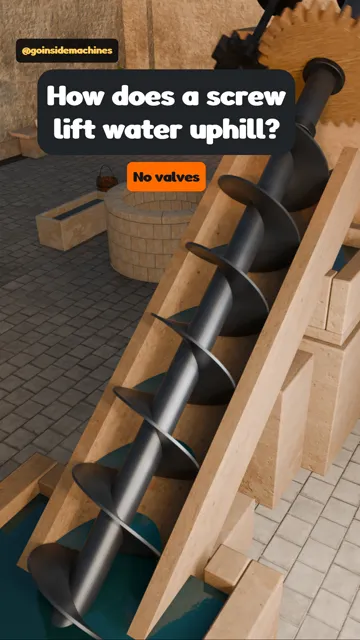
The Archimedes screw
How does a screw lift water uphill?
The question
Water only ever runs downhill. Yet tilt a long tube with a spiral blade inside it, turn the spiral, and the water climbs. There is no piston and no pump. So how does a screw lift water uphill?
Reveal answer
The screw does not push the water up a slope. It traps it. Tilt the screw and each turn of the spiral has a low point that holds a pocket of water, the way a bowl holds it. Turning the screw slides every pocket one pitch along the axis, which is up the slope. At the top, the pocket pours out. The water never climbs by itself. Each pocket is carried up.
Play
Turn the screw
Drag sideways on the screw, or press Turn once, to turn it. Each turn slides every blue pocket one pitch up, and the top one pours into the channel. Then slide the Tilt. Close to flat the pockets are big. As the screw gets steeper they shrink, and past the green band they are gone and the water slides back. Switch on Let it leak to see drops fall back over a flight.
What's happening
- 1
As the shaft turns, the bottom end scoops up water, and the rotating helix pushes it up until it pours out of the top. When the screw is tilted, buckets that trap water form between the blades and move up as it turns.
- 2
The screw in the short is 3.0 m long, with a pitch of 0.45 m: one turn of the spiral is 0.45 m along the axis. It is tilted on the 3-4-5 slope that Vitruvius described, 3 up for every 4 along, which is 36.9°.
- 3
One full turn slides every pocket up exactly one pitch along the axis. Along a 36.9° slope that is 0.45 × 0.6 = 0.27 m of height a turn. The screw is 3.0 ÷ 0.45 = 6.67 pitches long, so a pocket needs about 6 and two-thirds turns to ride from the pool to the channel, and it arrives 3.0 × 0.6 = 1.8 m higher. After that, one pocket pours out every turn.
- 4
A pocket is a low point on the edge of the spiral. Tilt the screw steeper and the dip gets shallower, until at about 77° there is no dip at all. Then nothing is trapped, and the water slides back down. Leaks do not ruin it: if water from one section leaks into the next lower one, the next segment carries it up again.
- 5
The earliest mention of the water screw is from between 250 and 220 BC, so it is over 2,000 years old. It was used as a bilge pump on a ship built for Hiero II of Syracuse, and for irrigation in the Nile Delta. It is traditionally credited to Archimedes, but its origins are unknown. Some scholars think he found it already in use in Egypt. Today, screw pumps are widely used in wastewater treatment plants and for draining low-lying land, because they cope well with varying flow and with solids. Modern screws replaced some windmills at Kinderdijk in the Netherlands. Run in reverse, the screw works as a small hydro turbine.
The maths
Follow the outer edge of the spiral. Let R be the outer radius, p the pitch, β the tilt of the axis from the horizontal and θ the angle round the axis. The height of the edge is
The first term climbs steadily as the edge winds along the axis. The second is a wave, because the edge goes round the axis. A pocket is a low point, where dz/dθ = 0, which gives sin θ = (p ÷ 2πR) × tan β. That has a solution only while (p ÷ 2πR) × tan β is less than 1, so pockets exist only while tan β < 2πR ÷ p. For the short, R = 0.30 m and p = 0.45 m, so 2πR ÷ p = 2π × 0.30 ÷ 0.45 = 4.19, and the limit is atan 4.19 = 76.6°. The 3-4-5 slope has tan β = 3 ÷ 4 = 0.75, which is well inside it, with β = 36.9° and sin β = 3 ÷ 5 = 0.6. The lift of a screw of axis length ℓ is ℓ sin β, so 3.0 × 0.6 = 1.8 m. One turn lifts the water p sin β = 0.45 × 0.6 = 0.27 m. The pitch and the radius set how steep the screw can go. The shaft radius, 0.085 m, does not appear in these formulas. The screw needs 3.0 ÷ 0.45 = 6.67 turns to carry a pocket the whole way.
Simplified, and sources
The widget is an ideal model. There is no friction, and no water leaks through the gaps between the flight and the casing, unless you switch on Let it leak. Each pocket is filled up to its lower crest, the most it can hold. The drawn pocket size is the dip of the flight's edge compared with a flat screw. Real pockets will hold different amounts, so the percentage shows how the pocket changes with tilt, not how much water a real screw lifts. The screw is drawn as an open trough with the near half cut away, like a modern screw pump. The classic screw has its spiral inside a closed tube. The pocket idea is the same, but a real screw does not hold exactly this much water. The drive is off screen, and the dial only shows the turns. You can turn the screw forward only, and it has one spiral, a single flight. The drawings are not to scale: the lift mark and the pool and channel are drawn only to show where the water goes.